
.svg)
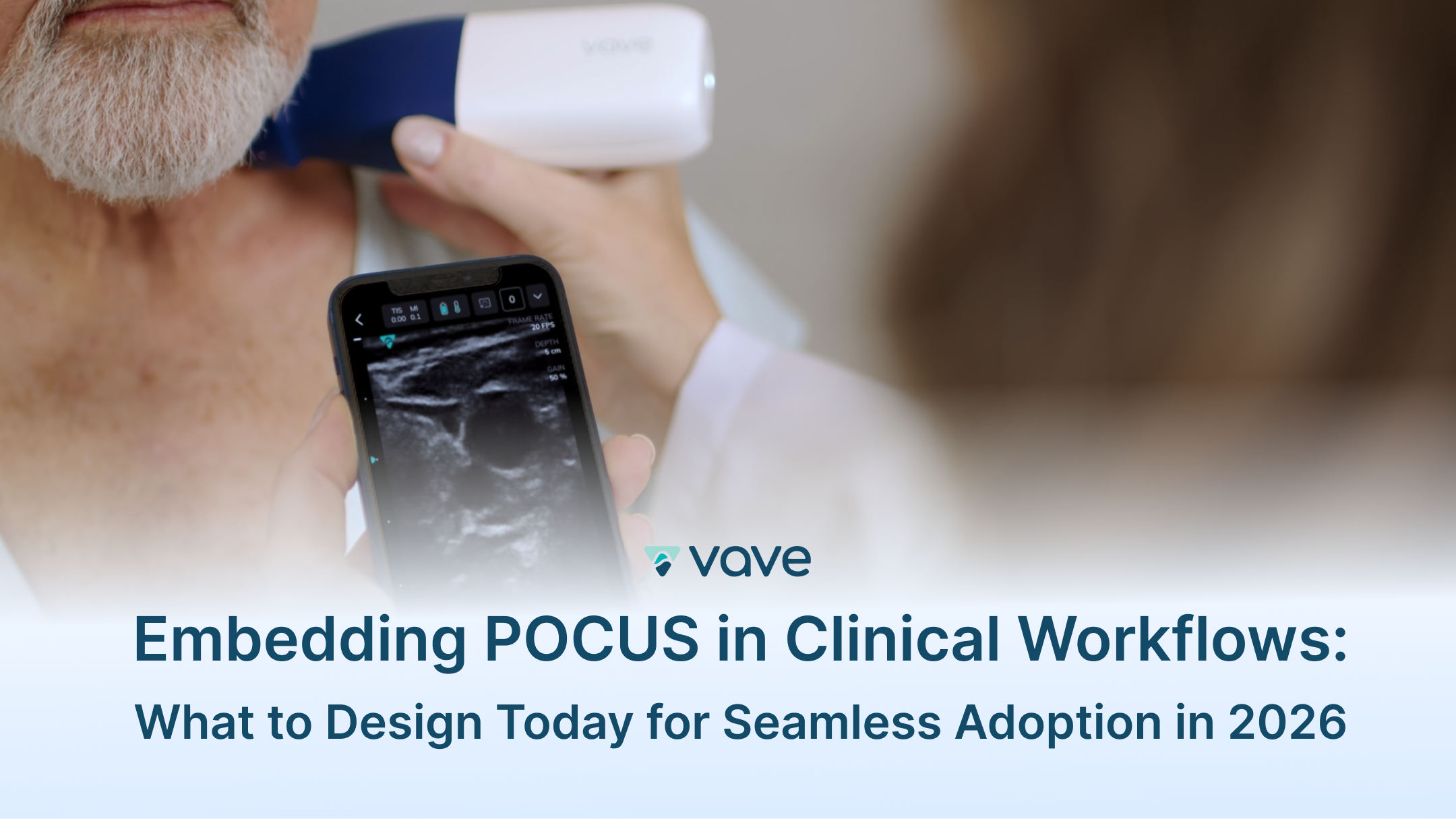
Demand for ultrasound is expected to rise by 16% in the coming years[1], and many healthcare practices believe such fast, high-precision imaging can transform patient care.
From emergency care to family physicians, a far wider range of clinicians will use point-of-care ultrasound (POCUS) devices to diagnose, monitor, and manage conditions. But integrating the technology into daily workflows at scale presents challenges.
This article explores those challenges and reveals how a few key steps can help you overcome them. Through careful planning and design, we will show how you can embed POCUS into clinical workflows with ease, and empower your clinicians and patients in 2026.
Our experience suggests practices should prioritize five key areas to prepare for a smooth POCUS implementation:
Practices must integrate training, credentialing, and regular reviews into their POCUS program.
POCUS training is often cited as a key barrier to POCUS adoption, but this is just the start. Image acquisition and interpretation skills decline after just 1-3 months,[2] making ongoing training a key to ensure the technology is properly utilized.
- Establish specialty-specific proficiency standards with tiered credentialing (basic, intermediate, advanced)
- Embed POCUS into existing rotations with protected scanning time, not separate add-on programs
- Create simulation-based training before anyone touches a real patient
- Pair novice learners with POCUS champions during regular shifts for real-time teaching
- Implement annual assessments and regular peer review sessions to maintain skills
Clinicians must be encouraged to use POCUS across a range of important scenarios.
Research shows that many POCUS-accredited clinicians don’t utilize the technology in their daily practice[3], often because the technology is not normalized within their workflows. However, there is a wide range of acute and non-acute conditions that POCUS can support with either diagnostics or fast, effective monitoring.
- Provide greater access to POCUS devices by opting for more affordable and flexible handheld devices
- Embed prompts into clinical workflows to remind clinicians that POCUS is available
- Clarify that bedside scanning doesn't need formal orders, just documentation
- Identify enthusiastic early adopters who can mentor colleagues during shifts
Effective ongoing learning requires regular feedback from experienced users.
Less experienced clinicians may lack the confidence in their POCUS skills, which inadvertently creates a feedback loop where they don't gain the practical experience needed for skill mastery and greater autonomy.
- Provide peer review within 24-48 hours with constructive feedback while cases are fresh
- Use AI-powered quality assessment for immediate guidance on technique
- Create immediate consultation channels for difficult cases
- Hold regular case conferences that correlate findings with formal imaging and outcomes
- Track quality metrics with root cause analysis when complications occur
POCUS documentation must be simplified to ensure consistent, compliant image sharing.
Research shows that clinicians know documenting and reporting ultrasound findings was important, but almost half lacked the skills required to do so.[4] This is compounded by issues with PACS integration and HIPAA compliance, creating difficulty for clinicians to quickly share images and gain feedback or expert support during diagnostics.
- Select PACS-integrated solutions with DICOM compatibility and long-term storage capacity
- Enable mobile documentation at the bedside to reduce workflow disruption
- Create specialty-specific EHR templates with standardized terminology for indication, findings, and interpretation
- Enable mobile documentation at the bedside to reduce workflow disruption [1] [2] [3] [4]
Effective POCUS programs require strong planning and management.
Multidisciplinary oversight prevents POCUS from becoming one department's responsibility. Clear institutional policies and phased implementation turn ambitious vision into practical reality. Start where your organization is today and build momentum through visible success.
- Establish a multidisciplinary oversight committee with a medical director and program coordinator
- Create clear institutional policies before problems arise
- Start with high-impact applications like trauma or procedural guidance
- Pilot programs in engaged departments to refine workflows before scaling
- Allocate resources that match ambition, including training time, equipment, and QA support
Vave Health is not just a provider of leading handheld POCUS devices; we also work with our partners to help them introduce the technology more effectively.
From building training curricula to developing effective workflows, we help practices of all sizes navigate the logistical, cultural, and practical challenges required toexpand POCUS usage.
Want to build a stronger POCUS program in 2026?
[2]https://link.springer.com/article/10.1007/s10459-025-10447-2
[3] https://link.springer.com/article/10.1007/s10459-025-10447-2#ref-CR43
[4] https://bmchealthservres.biomedcentral.com/articles/10.1186/s12913-024-11865-5
.svg)
.svg)
Demand for ultrasound is expected to rise by 16% in the coming years[1], and many healthcare practices believe such fast, high-precision imaging can transform patient care.
From emergency care to family physicians, a far wider range of clinicians will use point-of-care ultrasound (POCUS) devices to diagnose, monitor, and manage conditions. But integrating the technology into daily workflows at scale presents challenges.
This article explores those challenges and reveals how a few key steps can help you overcome them. Through careful planning and design, we will show how you can embed POCUS into clinical workflows with ease, and empower your clinicians and patients in 2026.
Our experience suggests practices should prioritize five key areas to prepare for a smooth POCUS implementation:
Practices must integrate training, credentialing, and regular reviews into their POCUS program.
POCUS training is often cited as a key barrier to POCUS adoption, but this is just the start. Image acquisition and interpretation skills decline after just 1-3 months,[2] making ongoing training a key to ensure the technology is properly utilized.
- Establish specialty-specific proficiency standards with tiered credentialing (basic, intermediate, advanced)
- Embed POCUS into existing rotations with protected scanning time, not separate add-on programs
- Create simulation-based training before anyone touches a real patient
- Pair novice learners with POCUS champions during regular shifts for real-time teaching
- Implement annual assessments and regular peer review sessions to maintain skills
Clinicians must be encouraged to use POCUS across a range of important scenarios.
Research shows that many POCUS-accredited clinicians don’t utilize the technology in their daily practice[3], often because the technology is not normalized within their workflows. However, there is a wide range of acute and non-acute conditions that POCUS can support with either diagnostics or fast, effective monitoring.
- Provide greater access to POCUS devices by opting for more affordable and flexible handheld devices
- Embed prompts into clinical workflows to remind clinicians that POCUS is available
- Clarify that bedside scanning doesn't need formal orders, just documentation
- Identify enthusiastic early adopters who can mentor colleagues during shifts
Effective ongoing learning requires regular feedback from experienced users.
Less experienced clinicians may lack the confidence in their POCUS skills, which inadvertently creates a feedback loop where they don't gain the practical experience needed for skill mastery and greater autonomy.
- Provide peer review within 24-48 hours with constructive feedback while cases are fresh
- Use AI-powered quality assessment for immediate guidance on technique
- Create immediate consultation channels for difficult cases
- Hold regular case conferences that correlate findings with formal imaging and outcomes
- Track quality metrics with root cause analysis when complications occur
POCUS documentation must be simplified to ensure consistent, compliant image sharing.
Research shows that clinicians know documenting and reporting ultrasound findings was important, but almost half lacked the skills required to do so.[4] This is compounded by issues with PACS integration and HIPAA compliance, creating difficulty for clinicians to quickly share images and gain feedback or expert support during diagnostics.
- Select PACS-integrated solutions with DICOM compatibility and long-term storage capacity
- Enable mobile documentation at the bedside to reduce workflow disruption
- Create specialty-specific EHR templates with standardized terminology for indication, findings, and interpretation
- Enable mobile documentation at the bedside to reduce workflow disruption [1] [2] [3] [4]
Effective POCUS programs require strong planning and management.
Multidisciplinary oversight prevents POCUS from becoming one department's responsibility. Clear institutional policies and phased implementation turn ambitious vision into practical reality. Start where your organization is today and build momentum through visible success.
- Establish a multidisciplinary oversight committee with a medical director and program coordinator
- Create clear institutional policies before problems arise
- Start with high-impact applications like trauma or procedural guidance
- Pilot programs in engaged departments to refine workflows before scaling
- Allocate resources that match ambition, including training time, equipment, and QA support
Vave Health is not just a provider of leading handheld POCUS devices; we also work with our partners to help them introduce the technology more effectively.
From building training curricula to developing effective workflows, we help practices of all sizes navigate the logistical, cultural, and practical challenges required toexpand POCUS usage.
Want to build a stronger POCUS program in 2026?
[2]https://link.springer.com/article/10.1007/s10459-025-10447-2
[3] https://link.springer.com/article/10.1007/s10459-025-10447-2#ref-CR43
[4] https://bmchealthservres.biomedcentral.com/articles/10.1186/s12913-024-11865-5
.webp)
With no hidden fees or other unwelcome surprises, Vave offers high-quality imaging at the best price.

